With the winding down of this blog, I have gathered the bottom-line information, here. The posts listed below cut to the chase: the cold hard stats that prove that Henry outperforms, not just the rest of the district, not just charters, but the state overall. Need objective proof that your kids won't necessarily do better in a charter, or suburban, or even a high-priced charter school? It's all right here.
There are many more posts with useful information throughout Knowing Henry. Parent testimonials. Information about the art and music programs, sports, trips, and more.
(some of the posts contain external links to news reports that may no longer be active)
How do the academics compare to other schools?
What do the numbers say?
Still more good news from PSSA
Private school advantage disappears
Little evidence that charter schools perform better
Why do parents choose Henry if they can afford other schools?
Why they chose Henry
Do I live in the Henry catchment?
Henry school boundaries
What do people do about after school?
After school Summit's just a block away
Showing posts sorted by date for query pssa. Sort by relevance Show all posts
Showing posts sorted by date for query pssa. Sort by relevance Show all posts
Saturday, December 05, 2009


Tuesday, April 22, 2008
Six Henry students accepted by Masterman
Six of Henry's fourth graders - 13 percent of the class - have been granted admission to Julia R. Masterman Middle School. According to Masterman staff during last October's parent information session, about 1,600 fourth graders apply from across the city for only 165 fifth grade slots at Masterman.
Masterman's middle school shows up at the top of the rankings for the PSSA, Pennsylvania's standardized testing system.
U.S. News and World Report ranked Masterman's high school at number 53 among the top 100 high schools in the nation.
Masterman's middle school shows up at the top of the rankings for the PSSA, Pennsylvania's standardized testing system.
U.S. News and World Report ranked Masterman's high school at number 53 among the top 100 high schools in the nation.
Saturday, April 12, 2008
April showers, PSSA flowers
Ah, spring is in the air. The redbuds are blooming outside Henry. The middle school dragonboat team is getting ready to hit the Schuylkill. Students are back to assembling in the upper school yard at the start of the day. And the annual PSSA bookends the month.
The Pennsylvania System of School Assessment, or PSSA, is the standardized test that measure's compliance with state goals under the federal No Child Left Behind act. Say what you want about NCLB, standardized testing, and the unfairness of it all.
Through the PSSA, Henry students prove, year after year, that this school shines - not just above other city schools, but ahead of the curve for their peers across the state. Overall scores best both city and state averages. Break down by grade and demographic, and Henry floats above the norm.
Want details? Take a look at Henry's 2007/08 Academic Achievement Report. You'll see that Henry not only met the state goals for reading and math, last year, but is already at the higher mark for 2007/08 for math. (NCLB goals rise each year, meaning good schools like Henry have to keep getting even better.)
See previous posts about Henry's PSSA results, here.
The Pennsylvania System of School Assessment, or PSSA, is the standardized test that measure's compliance with state goals under the federal No Child Left Behind act. Say what you want about NCLB, standardized testing, and the unfairness of it all.
Through the PSSA, Henry students prove, year after year, that this school shines - not just above other city schools, but ahead of the curve for their peers across the state. Overall scores best both city and state averages. Break down by grade and demographic, and Henry floats above the norm.
Want details? Take a look at Henry's 2007/08 Academic Achievement Report. You'll see that Henry not only met the state goals for reading and math, last year, but is already at the higher mark for 2007/08 for math. (NCLB goals rise each year, meaning good schools like Henry have to keep getting even better.)
See previous posts about Henry's PSSA results, here.
Tuesday, January 16, 2007
Test scores: a tale of two districts and charter schools too
(submitted by Susan DeJarnatt)
Test scores get way too much emphasis these days. No Child Left Behind (NCLB) largely reduces school quality to test scores: a very limited way of looking at all that can make up a school community. But test scores are a fact of life in the NCLB era. It is interesting to compare Henry’s test scores with those of much praised suburban and charter schools.
Pennsylvania complies with the testing requirements of NCLB through the PSSA tests which are administered yearly to students in grades 5, 8, and 11 and, as of last year, 3. Students’ scores are ranked as Advanced, Proficient, Basic, and Below Basic. NCLB requires that all students score at the Proficient level by the year 2014. Each state has to set benchmarks towards that goal and schools must make Adequate Yearly Progress towards the goal of 100% proficiency by hitting those benchmarks.
The Pennsylvania Department of Education website contains NCLB Report Cards for every traditional public and charter school in Pennsylvania. Students in grades 3, 5, 8 and 11 took the PSSAs in 2005-2006. Grades 5, 8, and 11 took the tests in 2004-2005. The NCLB Report Cards say how many students achieved Proficiency for these years. The Report Cards provide an overall score for the school, based on all of the students taking the test. They also provide a breakdown of the performance of students in the subgroups NCLB recognizes, including a breakdown by gender, ethnicity, students with Individual Education Plans and students labeled “economically disadvantaged.” The subgroup scores are listed only if there are at least 40 students in the subgroup at that school.
So how does Henry compare? Henry’s students matched or exceeded the Pennsylvania state averages for most of the grades and subgroups in both 2004-05 and 2005-06. The scores for black kids (NCLB term) are particularly striking. Henry’s black 8th graders beat the state math scores by 62% Proficient at Henry, compared to the state average of 33%. Their reading scores were also impressive: 72% Proficient, compared to the state average of 44%. Henry’s economically disadvantaged students exceeded the state averages in 5 out of 6 grade scores.
Henry’s data compare well to that of the 8 elementary and middle schools in the well-respected Lower Merion School District, too. Most of these schools lack sufficient numbers to have scores in the subgroups for economically disadvantaged and black students. The general scores for these schools are among the highest in the state, to be expected given they are also among the best-funded schools in the state. But Henry’s black students matched or exceeded the Lower Merion schools’ scores in 6 out of 8 categories in 2005-06, and in 4 out of 8 in 2004-05. Henry’s economically disadvantaged students exceeded the Lower Merion students in 6 out of 10 categories.
Finally, the biggest contrast is between Henry and the charter schools. I looked at the data for Christopher Columbus Charter School, Green Woods Charter School, Independence Charter School, KIPP Charter School, West Oak Lane Charter School, and Wissahickon Charter School. Henry’s overall and subgroup scores exceeded those from these charter schools in 67 out of 76 categories. Henry’s scores dominated those from Christopher Columbus and KIPP, completely surpassed those from West Oak Lane and Wissahickon, and closely matched those from Green Woods and Independence.
Test scores are only one aspect of a school. Henry has much, much more to offer than just test scores. But the success of Henry’s students on the tests is impressive and should be a source of confidence, not concern, about the school.
Test scores get way too much emphasis these days. No Child Left Behind (NCLB) largely reduces school quality to test scores: a very limited way of looking at all that can make up a school community. But test scores are a fact of life in the NCLB era. It is interesting to compare Henry’s test scores with those of much praised suburban and charter schools.
Pennsylvania complies with the testing requirements of NCLB through the PSSA tests which are administered yearly to students in grades 5, 8, and 11 and, as of last year, 3. Students’ scores are ranked as Advanced, Proficient, Basic, and Below Basic. NCLB requires that all students score at the Proficient level by the year 2014. Each state has to set benchmarks towards that goal and schools must make Adequate Yearly Progress towards the goal of 100% proficiency by hitting those benchmarks.
The Pennsylvania Department of Education website contains NCLB Report Cards for every traditional public and charter school in Pennsylvania. Students in grades 3, 5, 8 and 11 took the PSSAs in 2005-2006. Grades 5, 8, and 11 took the tests in 2004-2005. The NCLB Report Cards say how many students achieved Proficiency for these years. The Report Cards provide an overall score for the school, based on all of the students taking the test. They also provide a breakdown of the performance of students in the subgroups NCLB recognizes, including a breakdown by gender, ethnicity, students with Individual Education Plans and students labeled “economically disadvantaged.” The subgroup scores are listed only if there are at least 40 students in the subgroup at that school.
So how does Henry compare? Henry’s students matched or exceeded the Pennsylvania state averages for most of the grades and subgroups in both 2004-05 and 2005-06. The scores for black kids (NCLB term) are particularly striking. Henry’s black 8th graders beat the state math scores by 62% Proficient at Henry, compared to the state average of 33%. Their reading scores were also impressive: 72% Proficient, compared to the state average of 44%. Henry’s economically disadvantaged students exceeded the state averages in 5 out of 6 grade scores.
Henry’s data compare well to that of the 8 elementary and middle schools in the well-respected Lower Merion School District, too. Most of these schools lack sufficient numbers to have scores in the subgroups for economically disadvantaged and black students. The general scores for these schools are among the highest in the state, to be expected given they are also among the best-funded schools in the state. But Henry’s black students matched or exceeded the Lower Merion schools’ scores in 6 out of 8 categories in 2005-06, and in 4 out of 8 in 2004-05. Henry’s economically disadvantaged students exceeded the Lower Merion students in 6 out of 10 categories.
Finally, the biggest contrast is between Henry and the charter schools. I looked at the data for Christopher Columbus Charter School, Green Woods Charter School, Independence Charter School, KIPP Charter School, West Oak Lane Charter School, and Wissahickon Charter School. Henry’s overall and subgroup scores exceeded those from these charter schools in 67 out of 76 categories. Henry’s scores dominated those from Christopher Columbus and KIPP, completely surpassed those from West Oak Lane and Wissahickon, and closely matched those from Green Woods and Independence.
Test scores are only one aspect of a school. Henry has much, much more to offer than just test scores. But the success of Henry’s students on the tests is impressive and should be a source of confidence, not concern, about the school.
Tuesday, August 01, 2006
Philly schools still improving
As reported by Susan Snyder in Sunday's Inquirer, Philadelphia public schools are still posting improvements on the PSSA: Pennsylvania System of School Assessment.
Improvements last year came in:
Third grade reading and math
Eight grade reading
Eleventh grade reading and math
For all three grades, combined, the percentage of students scoring Advanced or Proficient from 2001/02 to 2005/06:
Increased from 19.5% to 41.8% in math
Increased from 23.9% to 39% in reading
Fifth grade posted a slight decrease in PSSA results, last year. Since 2001/02, Philly's fifth graders improved math results from 18.7% to 41.4%, and reading results from 20.8% to 31.7%.
The Pennsylvania Department of Education usually releases individual school results in September/October. Stay tuned to see how Henry fared.
Improvements last year came in:
Third grade reading and math
Eight grade reading
Eleventh grade reading and math
For all three grades, combined, the percentage of students scoring Advanced or Proficient from 2001/02 to 2005/06:
Increased from 19.5% to 41.8% in math
Increased from 23.9% to 39% in reading
Fifth grade posted a slight decrease in PSSA results, last year. Since 2001/02, Philly's fifth graders improved math results from 18.7% to 41.4%, and reading results from 20.8% to 31.7%.
The Pennsylvania Department of Education usually releases individual school results in September/October. Stay tuned to see how Henry fared.
Thursday, September 29, 2005
An equation for success: Test scores soar for area schools
From this week's Chestnut Hill Local, more on the great results from the 2004/2005 PSSA at Henry, Houston and Jenks.
Best line, from Henry Principal Caren Trantas:
“Our teachers have embraced our students. They’ve taken them in as their own. They’ve worked really hard at making sure students who are learning at all different levels understand the concepts.”
Best line, from Henry Principal Caren Trantas:
“Our teachers have embraced our students. They’ve taken them in as their own. They’ve worked really hard at making sure students who are learning at all different levels understand the concepts.”
Thursday, September 22, 2005
Still more good news from PSSA
The Inquirer this morning reports that Philadelphia elementary schools overall continued to improve their results in the Pennsylvania System of School Assessment (PSSA). Although I can't find the link online at the moment, the print edition lists 2004/2005 PSSA scores for 5th grades in southeast Pennsylvania.
Henry's 5th grades created a 16% increase in the number of students scoring Advanced or Proficient in math over 2003/2004, and a
58% increase in the past three years.
Henry's 5th grades showed a 2% drop from 2003/2004, but have created an overall
29% increase in the number of students scoring Advanced or Proficient in the past three years.
According to the Inquirer, "Advanced" means "superior academic performance," and "Proficient" means "satisfactory grade level performance."
Henry's 5th grades created a 16% increase in the number of students scoring Advanced or Proficient in math over 2003/2004, and a
58% increase in the past three years.
Henry's 5th grades showed a 2% drop from 2003/2004, but have created an overall
29% increase in the number of students scoring Advanced or Proficient in the past three years.
According to the Inquirer, "Advanced" means "superior academic performance," and "Proficient" means "satisfactory grade level performance."
Wednesday, September 21, 2005
Henry students beat city, state
A detailed review of Pennsylvania System of School Assessment (PSSA) results for the 2004/2005 school year (last year), shows that Henry students again bested district and state results in key measures.
Third Grade
79% of Henry's 3rd graders proved advanced or proficient in math:
27% higher than the district.
65% of Henry's 3rd graders proved advanced or proficient in reading:
28% higher than the district.
Henry's 3rd grade proved proficient in math at a rate
23% higher than the rest of the state.
Henry's 3rd grade proved proficient in reading at a rate
10% higher than the rest of the state.
Fifth Grade
71% of Henry's 5th graders proved advanced or proficient in math:
25% higher than the district.
56% of Henry's 5th graders proved advanced or proficient in reading:
21% higher than the district.
Henry's 5th grade proved proficient in math at a rate
2% higher than the rest of the state.
Henry's 5th grade proved proficient in reading at a rate
5% higher than the rest of the state.
Eighth Grade
68% of Henry's 8th graders proved advanced or proficient in math:
29% higher than the district.
72% of Henry's 8th graders proved advanced or proficient in reading:
32% higher than the district.
Henry's 8th grade proved proficient in math at a rate
11% higher than the rest of the state.
Henry's 8th grade proved proficient in reading at a rate
1% higher than the rest of the state.
As noted in the Inquirer, the federal No Child Left Behind act's goals for schools were higher in 2004/05 than the year before. Schools that made "adequate yearly progress" in 2003/04 could not slide on the same rate of progress in 2004/05: the improvement curve was steeper.
According to the Pennsylvania Department of Education, in 2004/05, NCLB required schools to have: "at least 45% of the tested students achieve Proficient or higher on the mathematics assessment and 54% of the tested students achieve Proficient or higher on the reading assessment." Not only did Henry students cruise past the NCLB standard, they passed many of their suburban peers - the Inquirer notes several suburban districts that met a lower NCLB standard in 2003/04, but couldn't meet the higher standards in 2004/05.
For a detailed look at Henry's 2003/04 results, see What do the numbers say?.
Third Grade
79% of Henry's 3rd graders proved advanced or proficient in math:
27% higher than the district.
65% of Henry's 3rd graders proved advanced or proficient in reading:
28% higher than the district.
Henry's 3rd grade proved proficient in math at a rate
23% higher than the rest of the state.
Henry's 3rd grade proved proficient in reading at a rate
10% higher than the rest of the state.
Fifth Grade
71% of Henry's 5th graders proved advanced or proficient in math:
25% higher than the district.
56% of Henry's 5th graders proved advanced or proficient in reading:
21% higher than the district.
Henry's 5th grade proved proficient in math at a rate
2% higher than the rest of the state.
Henry's 5th grade proved proficient in reading at a rate
5% higher than the rest of the state.
Eighth Grade
68% of Henry's 8th graders proved advanced or proficient in math:
29% higher than the district.
72% of Henry's 8th graders proved advanced or proficient in reading:
32% higher than the district.
Henry's 8th grade proved proficient in math at a rate
11% higher than the rest of the state.
Henry's 8th grade proved proficient in reading at a rate
1% higher than the rest of the state.
As noted in the Inquirer, the federal No Child Left Behind act's goals for schools were higher in 2004/05 than the year before. Schools that made "adequate yearly progress" in 2003/04 could not slide on the same rate of progress in 2004/05: the improvement curve was steeper.
According to the Pennsylvania Department of Education, in 2004/05, NCLB required schools to have: "at least 45% of the tested students achieve Proficient or higher on the mathematics assessment and 54% of the tested students achieve Proficient or higher on the reading assessment." Not only did Henry students cruise past the NCLB standard, they passed many of their suburban peers - the Inquirer notes several suburban districts that met a lower NCLB standard in 2003/04, but couldn't meet the higher standards in 2004/05.
For a detailed look at Henry's 2003/04 results, see What do the numbers say?.
Wednesday, June 22, 2005
What do the numbers say?
"Statistics are like bikinis. What they reveal is suggestive, but what they conceal is vital." ~Aaron Levenstein
You can use statistics to decide if a school is the right one for your child. But what stats do you use? And what do they say? Here are two links to vital stats for Henry, both are the most recently published.
You can use statistics to decide if a school is the right one for your child. But what stats do you use? And what do they say? Here are two links to vital stats for Henry, both are the most recently published.
- Henry's No Child Left Behind report card, 2003/04
- Henry's PSSA results, 5th Grade as reported in Inquirer for 2003/04 (you can get to the Inky's report on 3rd and 8th grade from this link)
Looking at the upper end of the stats, here's what the NCLB report says for the 2003/04 school year:
- In at least 12 measures, Henry students perform better than their peers throughout Pennsylvania.
- In at leat 18 measures, Henry students perform better than their peers throughout the district.
For the specific stats:
- Henry's 5th graders were 23.7% more likely to be Proficient or Advanced in math than the rest of the district.
- Henry's 5th graders were 24.6% more likely to be Proficient or Advanced in reading than the rest of the district.
- Henry's 8th graders were 16.9% more likely to be Proficient or Advanced in math than the rest of the district.
- Henry's 8th graders were 34.2% more likely to be Proficient or Advanced in reading than the rest of the district. And 6.4% more likely to be Proficient or Advanced in reading than THE REST OF THE STATE.
For all grades combined for the 2003/04 school year:
- Henry students were 23% more likely to be Proficient or Advanced in math than the rest of the district.
- Henry students were 34.4% more likely to be Proficient or Advanced in reading than the rest of the district. And 3.7% more likely to be Proficient or Advanced in reading than THE REST OF THE STATE.
For male students:
- 18.1% more likely to be Proficient or Advanced in math than the rest of the district.
- 26% more likely to be Proficient or Advanced in reading than the rest of the district.
For female students:
- 26.7% more likely to be Proficient or Advanced in math than the rest of the district. And only 0.3% less than THE REST OF THE STATE.
- 40% more likely to be Proficient or Advanced in reading than the rest of the district. And 10% more than THE REST OF THE STATE.
For white students:
- 18.9% more likely to be Proficient or Advanced in math than the rest of the district. And 6.7% more than THE REST OF THE STATE.
- 35.4% more likely to be Proficient or Advanced in reading than the rest of the district. And 18.8% more than THE REST OF THE STATE.
For black students (the term used in the NCLB report):
- 25.8% more likely to be Proficient or Advanced in math than the rest of the district. And 21.5% more than THE REST OF THE STATE.
- 34.8% more likely to be Proficient or Advanced in reading than the rest of the district. And 28.2% more than THE REST OF THE STATE.
For economically disadvantaged students:
- 25.8% more likely to be Proficient or Advanced in math than the rest of the district. And 16.8% more than THE REST OF THE STATE.
- 37.5% more likely to be Proficient or Advanced in math than the rest of the district. And 25.4% more than THE REST OF THE STATE.
For students with disabilities:
- 13.8% more likely to be Proficient or Advanced in reading than the rest of the district. And 0.4% more than THE REST OF THE STATE. (although 0.2% less likely to be Proficient or Advanced in math than their peers in the rest of the district, and 12.5% less than the rest of the state)
Henry's attendance rate:
- 4% better than the district and 1.1% better than THE REST OF THE STATE.
Are there failing kids at Henry? You bet. Are there kids without family educational support at Henry? Yes. But the reality is that for kids in families where education is important - including economically disadvantaged families and minority families - Henry is a place where the statistics prove they can learn and excel.
Tuesday, May 24, 2005
Powerful Parental Participation
If you google Margaret Meade's famous quote about not underestimating the power of a small group to change the world, you learn that either (a) she said it about 14,519 different times and used different wording each time, or (b) the quote has such rallying power for small groups trying to do good work, that folklore has morphed it into a fluid description of the 80/20 rule we all see in our working lives: most of the work is done by a small group of people.
Henry's Home and School Association feels like a Meade illustration in action. At the group's meeting last week, we got a report of its activities this school year. An abbreviated list of accomplishments includes:
Henry's Home and School Association feels like a Meade illustration in action. At the group's meeting last week, we got a report of its activities this school year. An abbreviated list of accomplishments includes:
- Worked with the school to garner $350,000 from the district's Campus Parks program to redesign the upper school yard. The project, currently slated for demolition/construction in Summer 2006, will level the slope, install plantings and benches, and make the area a much more inviting and user-friendly space.
- Worked with the Community Design Collaborative, a group of Architects working to improve public spaces, to explore ways of improving the lunchroom. The lunchroom is really a multi-purpose room, a combination gym/lunchroom that works better as a gym than a soothing place for midday repast. The lunchroom has been a concern and complaint of parents, so the results of the CDC input should be a big help.
- Served as the spearhead and point of contact for staff from organizations like the Morris Arboretum, Schuylkill Center for Environmental Education, and school neighbors with real expertise who want to help improve the school environment.
- Provided support - like breakfasts and snacks - to the students during the testing periods for the PSSA and Terra Nova tests. Apparently, the research shows that sugar (or at least a decent breakfast) actually does help kids in testing.
- Coordinated volunteers from the Retired Senior Volunteer Program, which brings retired neighborhood residents into the school, weekly, to do one-on-one tutoring with students referred by their classroom teachers.
- Produced 2 fundraisers that netted about $20,000, which H&S basically "grants" to the school for needed items that aren't in the school budget, for example: instruments for the music program, a new laminator for the teachers, test prep books to help students and families prepare for the PSSA and Terra Nova tests, and field trip fees for students whose families can't pay the nominal costs.
One mother involved in H&S worked with the music teacher and Principal to write a proposal to a local foundation, resulting in a planning grant for the music program. That grant came through this year, and as part of the planning project, every family received a questionnaire about music and performing arts. Survey results went into the just-submitted proposal to the same foundation for a multi-year project to integrate music into the core curriculum, with a musician-in-residence working with classroom teachers. We should hear from the foundation in June.
Yes, a small group of folks work on these big accomplishments. At last week's meeting, 10 parents, representing Henry's diverse community, attended, along with the Principal. As a snapshot of parental involvement, attendance is not quite overwhelming. On the other hand, this was the night before the annual spring concert, there really weren't any critical items on the agenda, and the level of parental-participation goes way beyond meeting attendance. For example:
- There's a father who's a prof at a local university who, for the past two years, has arranged for student teachers throughout the school. This cuts in half the student-to-adult ratio in many classrooms. In my son's class, the 22 kids enjoyed a 11:1 ratio most of the year.
- There's a mother who coordinates the recycling project for used printer cartridges and cell phones, raising more funds for H&S to provide the school.
- There are the many parents who go along on field trips to the Zoo, Kimmel Center, Art Museum, and so many other great educational and cultural venues throughout the area.
- There are the parents working with the students on the annual school play: the producer/director who was recently in the Production department at the Philadelphia Opera Company, and more recently in one of the company's operas (OK, she was at the meeting); the musicians and sound technician.
- The parents who volunteered to run, and just plane help out at the book fairs/fundraisers, candy/stuff fundraisers.
- The parents and grandparents - someone just about everyday - who go into the classrooms to talk to students about their careers, teach science lessons, read to kindergarten, and teach students how to play Chess.
Wednesday, May 18, 2005
The Drop-Off
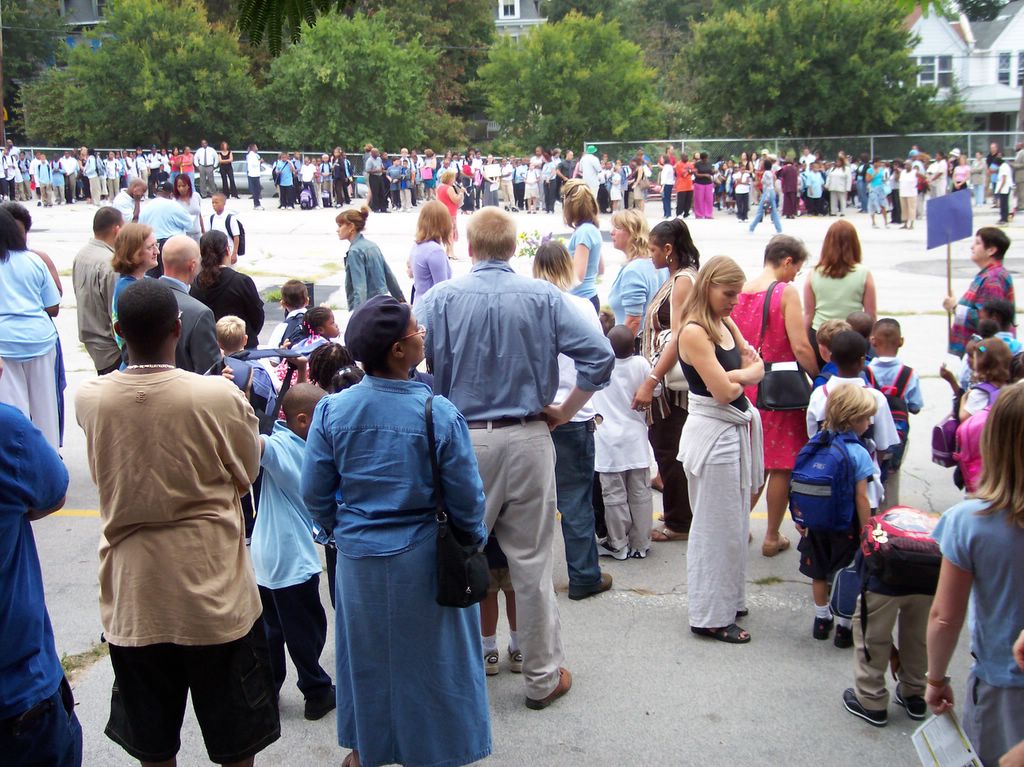
Assembling in the upper school yard. (photo KP)

You know that scene in Finding Nemo when Marlin takes Nemo to school for the first time? Not the part about the Drop-Off, forget that. But the part where they show up to drop off Nemo, and all the parent fish are hanging out talking as their kids go over to join the school. That part.
Taking a kid to Henry in the morning is like that. Lots of kids streaming into the schoolyard from all corners. Some kids are jumping Double Dutch by the stairs, others are racing by the fence, others are dutifully anticipating the call to assemble. And parents scattered throughout - some are spending a final few minutes with their kids, some are talking to the groups of kids that inevitably gather around them, while others are congregating in small groups to talk about a run to Infusion for a hit of caffeine on the way to work.
Throughout the year, the entire school starts off the day by assembling in the school yard on nice-weather days. Starting the day with everyone there - kids, teachers, parents, little bothers and sisters - helps create a sense of community. I meet the kids that my son talks about. I meet many of their parents - some I see most mornings, some every once in a while.
Dropping off our son at school is an immersion in community. I get hugs from Shelby, high-fives from Rondell, and the morning report on who's being unfair to Sean - all while my son is running foot races with kids ranging from kindergarten to fourth graders. I talk to one father about the bike ride coming up this weekend, to another about how the sound system makes the morning announcements sound like they're coming from an adult in Peanuts, and to a mom about the opera she's in at the moment.
After the teachers take the kids inside to start class, there are usually a couple of huddles of parents who don't have to rush off to work, talking about the upcoming fundraiser, the PSSA or Terra Nova tests or results, the Home & School meeting, or the school play. I am one of the parents who usually does have to rush off to work, but I often get a chance to say Hi and catch any important bullet points or get volunteered to write a letter to raise funds for the play.
Also after the kids go inside, the Principal is often out there long enough to talk about a problem or an opportunity. Plenty of times, I've caught her for a minute, and I feel I'm more rushed than she is.
Subscribe to:
Posts (Atom)
